




Online course by Institution School
Duration: Jan 17 – Apr 22, 2026
Fee: Full course is €350 (Early Bird rate of €250 until 28 December). Reduced fees apply for specific groups: €180 for students under 26, €220 for teachers, and €180 for residents of lower-middle and lower income countries. Individual lessons can be purchased for €25/€18 for students under 26.
Live sessions: Wednesdays at 6 PM CET and Saturdays at 3 PM CET (two 2-hour session per week)
Where: Live on Zoom (recordings and additional materials included)
Art history has never been neutral.
The course Decolonized History of Art, from Institution School, is one of the first sustained efforts to trace modern and contemporary art from a truly global perspective.
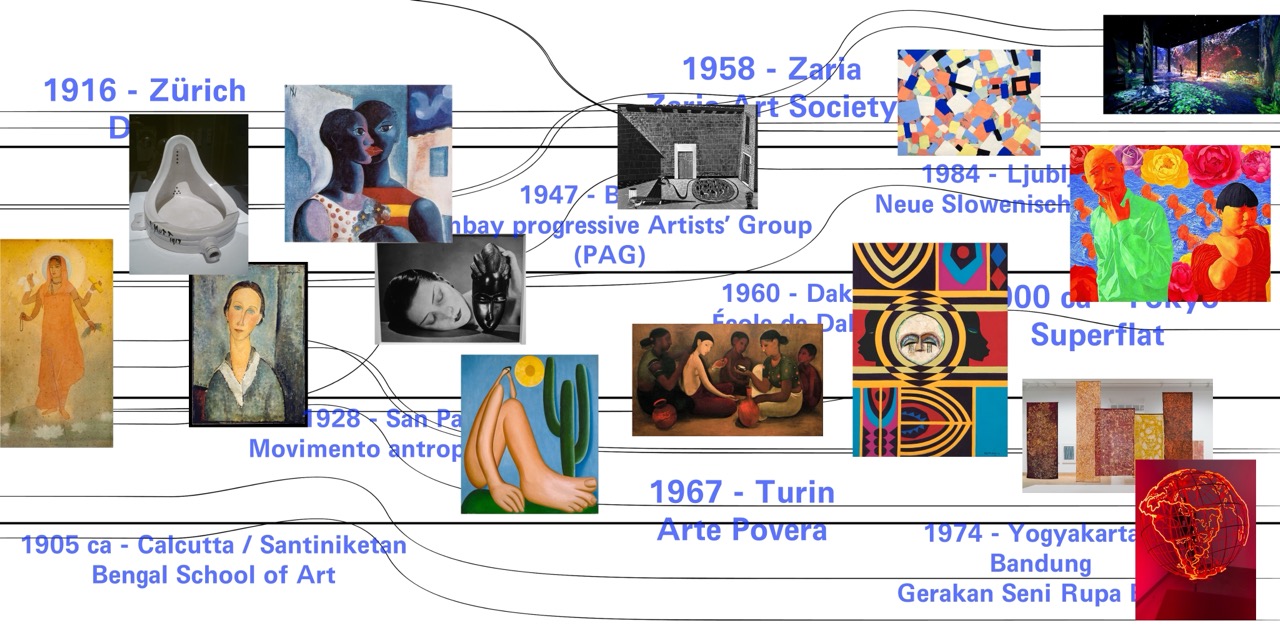
Across 24 online lessons, from mid-January to late April, participants will engage with an expansive and diverse range of artistic practices. These include the anti-colonial modernist movements of South Asia such as the Bengal School of Art and the Calcutta Group; Black diasporic modernisms, including the Harlem Renaissance and Caribbean avant-garde circles; Mexican and Chilean muralism, Brazilian Neo-Concretism, and the Anthropophagic movement; and modernist and calligraphic experimentation in North Africa and West Asia, exemplified by the Baghdad Modern Art Group and Algerian avant-garde circles. Postwar experimental collectives in East and Southeast Asia, such as Gutai, Mono-ha, and Dansaekhwa, are also examined, alongside pan-African cultural movements, experiences like the Kinshasa School, as well as the Hurufiyya movement and abstract modernism in West Asia. The course further explores Indigenous artistic expressions – including the work of Andean indigenist artists like José Sabogal, Julia Codesido, and Camilo Egas in Latin America and Rover Thomas and Emily Kam Kngwarray in Australia, as well as the political use of folklore in collectives like Las Arpilleras in Latin America – bringing these practices to light within broader art historical narratives. At the same time, the traditional Western trajectory of contemporary art is addressed – from early avant-garde movements such as Futurism and Constructivism, through the Neo-Avant-Garde with Abstract Expressionism and Fluxus, to Postmodernism and the present – critically addressing their colonial and often ambiguous elements.
The course highlights forefront voices, movements, and practices that have long been overlooked, positioning them as central to understanding the evolution of artistic production, and inviting participants to explore connections across time and geography. Guided by leading scholars and curators including Ute Meta Bauer, Nicolas Bourriaud, Tandazani Dhlakama, Charles Esche, Raphael Chikukwa, Gaudêncio Fidelis, Beáta Hock, Đỗ Tường Linh, Viktor Misiano, Morad Montazami, Samantha A. Noël, Anda Rottenberg, Shukla Sawant, Nada Shabout, R. Siva Kumar, Midori Yoshimoto, among others, the course strives to generate a unified yet plural history of art, examining and bringing together the diverse art histories that have developed across regions and periods and revealing the complexity of global artistic production.
Register now on Eventbrite & visit our website to learn more about Institution School, the course, prices and registration procedure. For any questions or if you need any further information, please contact decolonizedart.subscriptions@institution.it.
Image credits: Decolonized History of Art – Global Narratives from 1900 to the Present. Main Picture. © 2025 Institution SRL. All rights reserved.