







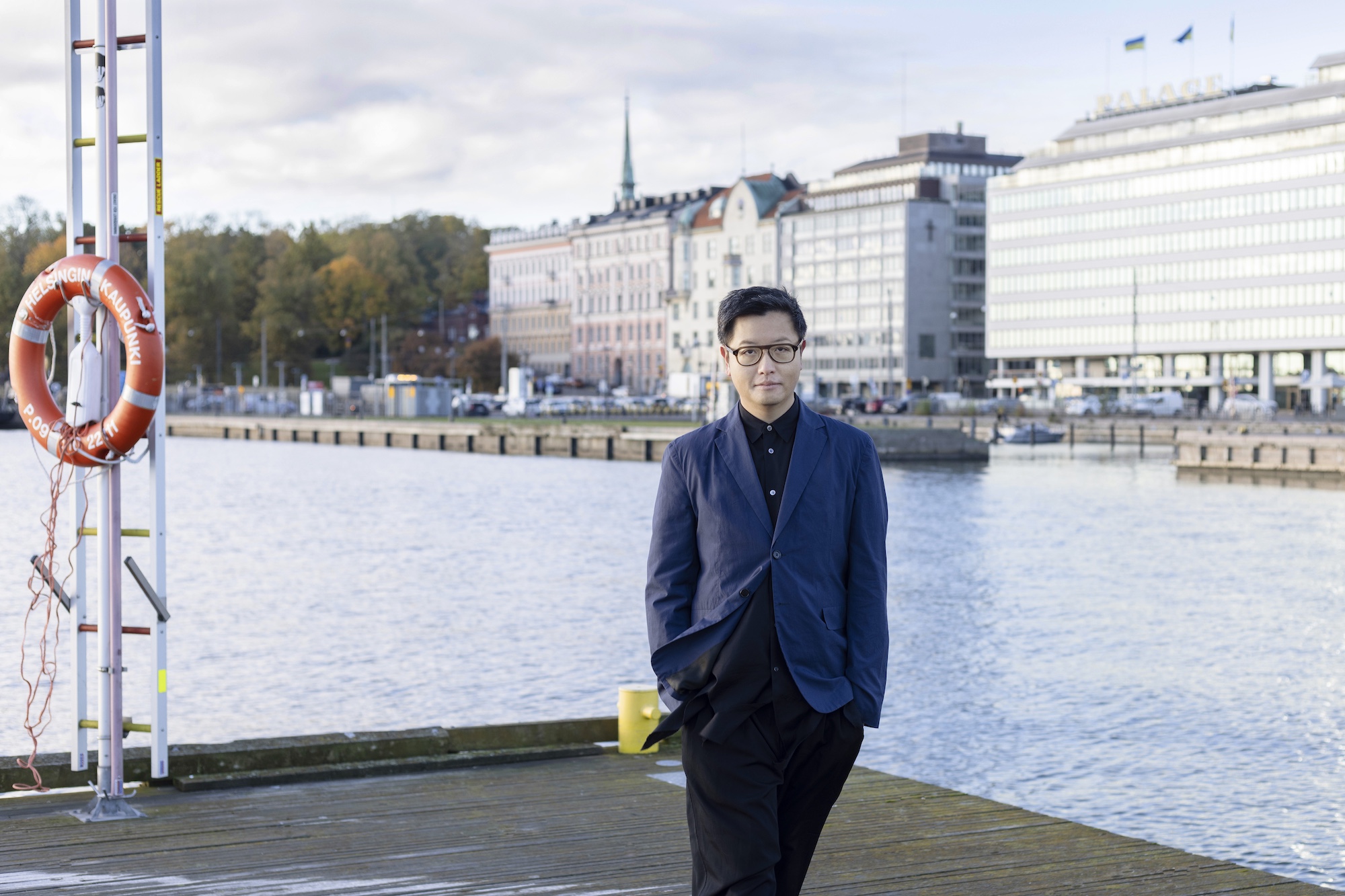
Carson Chan: Curating Architecture Across Collapsing Boundaries
#curator #Curatorial Practices #interviewRecently, Carson Chan was appointed Chief Curator and Director of Curatorial Affairs of the new Museum of Architecture and Design Helsinki, one of the most ambitious cultural projects in Finland’s recent history. Ahead of the museum’s opening in a new purpose-built home in Helsinki’s South Harbour in 2030, Chan will begin shaping its curatorial and research vision during a crucial transitional period.
With a practice spanning experimental project spaces, biennials, and major museums, Chan has consistently challenged the boundaries of architecture, foregrounding its entanglements with ecology, justice, and the climate polycrisis. As he prepares to take on this new role, Call For Curators invited Chan to reflect on his curatorial journey, his understanding of architecture as an environmental and social discipline, and his vision for what an architecture and design museum can be in a moment of planetary urgency.
Call For Curators: Can you tell us about your journey, how you got started in curatorial work, and what drives your passion today?
Carson Chan: There is a student gallery in Cornell University’s architecture school where I got my undergrad degree. I made an exhibition featuring the work of some NYC-based fashion designers there. That was my first exhibition and I think I was pretty quickly hooked to the idea of organizing objects in a space for people to look at together. I got a job as an architect in Berlin after grad school in 2005 but it didn’t take long for me to realize that I enjoyed thinking about architecture more than designing it. I found work at the Neue Nationalgalerie assisting Andres Lepik, the architecture curator, and during this time, with a friend from grad school, I opened a project space called PROGRAM that experimented with different ways to exhibit architecture. Architecture and design is about figuring out how we live on this planet, and I think I’m as excited about this as I’ve ever been. How humankind shapes the environment, its shelter, is how it shapes itself. The climate polycrisis we find ourselves in transforms this passion into an urgent, public matter.
 Photo: Ethan Hayes-Chute, PROGRAM e.V., photographer: Hans-Georg Gaul (2009)
CFC: Your work often collapses the boundaries between architecture, design, ecology, and social justice. How has your thinking about what architecture is evolved over the course of your career?
CC: Making architecture exhibitions has forced me to expand the way I define it. When we go to art exhibitions we see the actual artworks. At architecture exhibitions we see representations of buildings. If architecture required some kind of mediation (unless you build a full sized structure outdoors or in the gallery), could there be other ways or media to exhibit architectural ideas? This was our preoccupation at PROGRAM. We would ask artists, musicians, choreographers, and other non-architects to make architecture exhibitions. What would that look like? Could we still call it architecture? So, really, collapsed boundaries have been part of my curatorial strategy for the last two decades. When I began working at MoMA in 2021 as the inaugural director of the Ambasz Institute, a research institute that looked at the dynamics between the so-called built and natural environment, I saw many more disciplinary boundaries blur. Nothing is untouched by the climate polycrisis. Everything we do is now changed by it.
 Photo: Emerging Ecologies, MoMA (2023)
CFC: Ahead of the Museum of Architecture and Design in Helsinki’s new building’s opening in 2030, what do you see as your most urgent priorities during the transitional years?
CC: I want to use the time before the opening of the new museum to introduce our audiences to some of the themes and ideas we’ll be looking at in the years ahead. Through lectures, panel discussions, videos, screenings, publications, and outdoor commissions, we can accomplish a lot before the new building. I don’t see architecture and design as only concerned with objects, but rather with processes. It is as processes that these disciplines more fully contribute to global conversations about climate, justice, and issues around indigeneity, which have particular resonance in Finland where many Sámi people live. At the same time, both the Design Museum and the Museum of Finnish Architecture have incredibly rich, storied, legacies. I would love to find ways to celebrate these histories internationally in the coming years.
CFC: You’ve emphasised that architecture has historical roots in ecology and justice. How should institutions today respond to that lineage and responsibility?
CC: Architecture is an environmental discipline – I think many architects have until recently forgotten that. Environmental issues concern groups of people, entire communities, and are inherently connected to issues of justice. Institutions – whether schools, museums, or otherwise – should set an example for their publics to model. Architecture institutions in particular should do the hard work of rethinking the entire enterprise of the building sector – a segment of human activity that produces about 40% of the world’s yearly greenhouse gases.
CFC: Looking back at your interviews with figures ranging from Thomas Demand to Rick Owens to David Simon, which conversations have most shaped your thinking?
CC: I don’t think any one conversation has shaped my thinking, but it was the practice of interviewing creative people for over a decade that has taught me other ways to see the world, to appreciate how creative people manage businesses, and to understand the importance of the administrative side of any creative endeavor. I never really thought of it this way, but in retrospect, interviewing some of the people I admire most has been a huge part of my education.
 Photo: Architecture and Design Museum Helsinki, JKMM (2025)
CFC: You’ve worked across biennials, research institutes, independent project spaces, and major museums. What have these different institutional scales taught you about what museums can and cannot do? And how would you translate these lessons into your new role?
CC: Museums are very visible public institutions and as such, their programing and operations is seen not only by its immediate audience and community, but by the larger global public. Museums should model themselves a future they want to see, allowing artists, architects, and designers to help shape what this future might look like. Museums don’t write policy, but understanding that it can be an agent for cultural transformation, and understanding how this transformation works, makes them really powerful social instruments.
CFC: What advice would you give to someone wanting to pursue a career as a curator today?
CC: Just start making shows wherever you can! Hans Ulrich Obrist famously made exhibitions in his apartment kitchen as a young man. Especially if you’re just starting out, work with people in your generation. Grow together. This was one of the best pieces of advice I received when I first started making exhibitions. For me, the curator is really a mediator between the work (and its creator), the exhibiting institution, and the audience. The needs of each group need to be met, of course, but in the end, you should see yourself as an author as well. Take an authorial position.
CFC: If logistics, budgets, and laws of physics weren’t a constraint, what is the dream or delightfully impossible exhibition you’d love to stage?
CC: If I could travel back in time, I would love to work on the International Building Exhibition (Interbau), which opened in Berlin in 1957. It was an architecture exhibition in which each exhibitor was commissioned to build a fully functioning housing block. To see the exhibition, visitors walked around this newly created neighborhood, or else they’d ride on a cable car that took them above the whole area, seeing the buildings from above as if they were models. Architects like Oscar Niemeyer, Arne Jacobson, Alvar Aalto, and Walter Gropius were just some of the names that designed for this exhibition. I’ve worked on a city-wide scale in Marrakech and Denver, and the 1957 Interbau exhibition was always on my mind.
 Photo: Elín Hansdóttir, Mud Brick Spiral, Marrakech Biennale 4 (2012)
Bio
Carson Chan is the newly named Chief Curator and Director of Curatorial Affairs at the Architecture and Design Museum in Helsinki, where he provides the comprehensive intellectual vision for the museum and oversees the strategic planning, development, and implementation of the museum’s content-related programming, including exhibitions, collections, publications, diverse research initiatives, and audience engagement. In 2021, he was appointed Director of the Emilio Ambasz Institute for the Joint Study of the Built and Natural Environment at the Museum of Modern Art (NYC), where he was also Curator of Architecture and Design. There, he developed and led the Institute’s manifold research initiatives through a range of programming including exhibitions, public lectures, discussions, academic conferences, and publications. Chan’s first exhibition at MoMA, Emerging Ecologies: Architecture and the Rise of Environmentalism (2023-4), the largest survey of environmental architecture in the United States, crucially recentered architecture as an environmental discipline.
In 2012 Chan curated the 4th Marrakech Biennale (with Nadim Samman), and in the following year he served as executive curator of the Biennial of the Americas in Denver. Much of his curatorial work explores the disciplinary boundaries of architecture. In 2004 he founded PROGRAM: Initiative for Art and Architecture Collaborations, a project space and residency program in Berlin, with Fotini Lazaridou-Hatzigoga. In 2013 he co-convened a three-day conference at Yale School of Architecture called Exhibiting Architecture: A Paradox?, which was anthologized by Actar Publishers.
Chan regularly contributes to several publications, including Art Papers, Frieze, Log, Texte zur Kunst, and 032c, where he was formerly editor-at-large. He has contributed to several catalogues and monographs, and most recently he edited Richard Hamilton and Sigfried Giedion: Reaper (2017), a volume of commissioned essays about the architectural and artistic significance of early technological developments in farm machinery; and Life Forms: Essays on the Artwork of Andreas Greiner and the Display, Synthesis, and Simulation of Life (2020), the first book-length study of Andreas Greiner’s scientifically informed art. Chan’s academic research focuses on the 20th-century convergence of architecture, ecology, climate, and media. His doctoral work at Princeton tracks the architecture of postwar public aquariums in the United States during the rise of environmentalism and examines how these institutions evolved with the advancing discourse on Cold War statecraft, civil rights, environmental racism, and food security.