







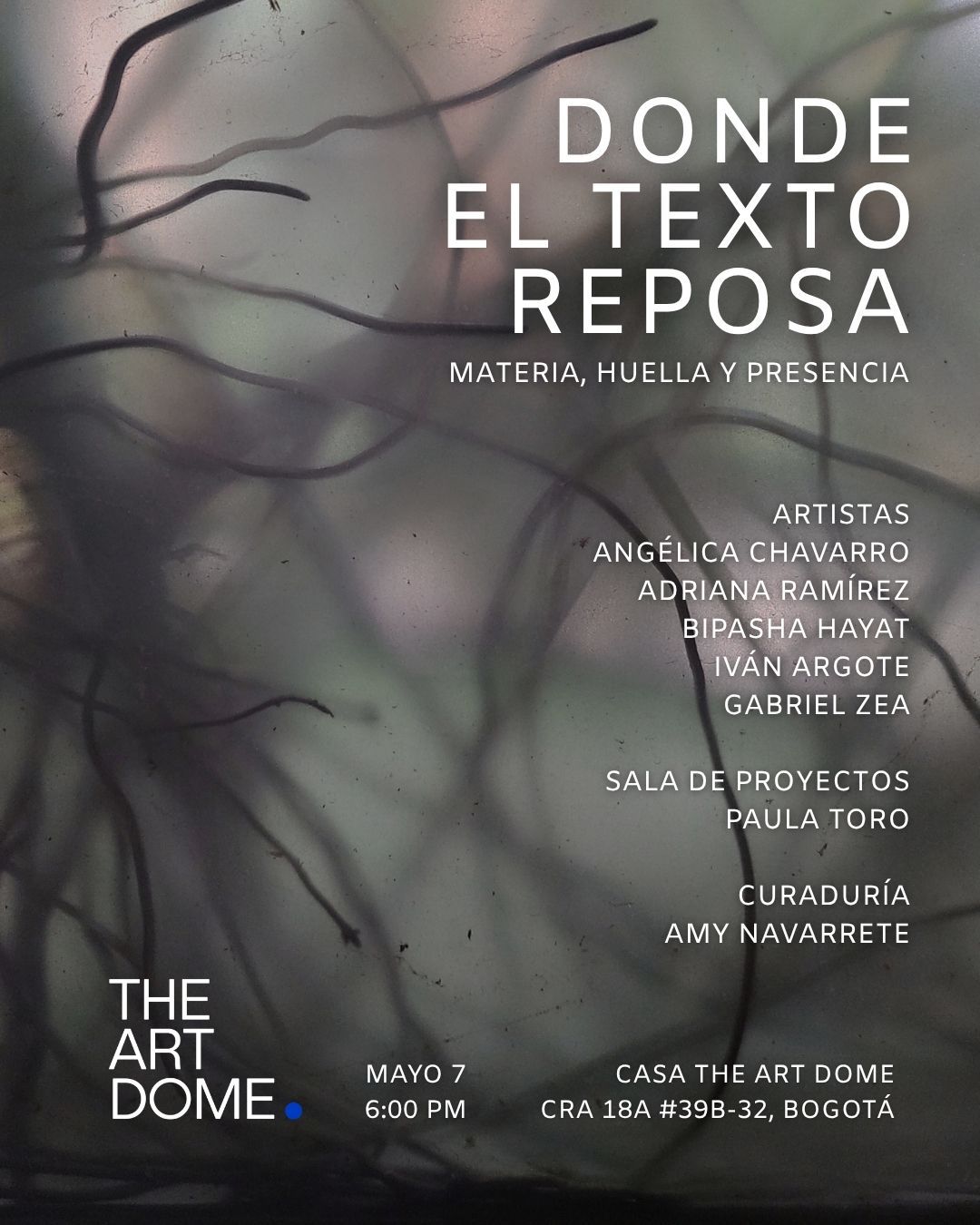
Art Guide: Donde el Texto Reposa (Where the Text Rests) curated by Amy Navarrete
#Art GuideIn this edition of the CFC Art Guide, we spotlight Donde el Texto Reposa (Where the Text Rests), an exhibition curated by Amy Navarrete that explores the relationship between language, materiality, memory, and the surfaces that support inscription.
Donde el Texto Reposa (Where the Text Rests), curated by Amy Navarrete
Featured artists: Iván Argote, Angélica Chavarro, Bipasha Hayat, Andriana Ramírez, Gabriel Zea
Dates: Until 3 July 2026
Opening times:
Location: The Art Dome House, Bogotá, Colombia
Text does not emerge in order to express.
It emerges in order to structure reality.
Before becoming literature or discourse, it was a form of inscription: marks on stone, pigment on walls, incisions on surfaces intended to preserve memory. From its origin, text has always been inscribed within the material that supports it. Writing does not exist in the abstract; it always rests upon something.
This exhibition begins with the relationship between language and support, and with how these shape our perception of what is inscribed. Is a text engraved in stone more important than one written on an ephemeral material such as paper?
In this sense, materials are not neutral. Texts inscribed in stone or metal evoke permanence, authority, and historical construction; they occupy a field where language becomes linked to power and collective memory. Those that appear on more fragile materials, such as fabric or paper, tend to activate a different scale: more intimate, more unstable, where text shifts toward the affective and the interior. Yet these associations are not fixed: it is precisely in their displacement that meaning ceases to be evident and begins to be put into play.
In the works of Iván Argote, Gabriel Zea, and Adriana Ramírez, the relationship between language and materiality does not merely affirm the permanence of inscription, but also questions it.
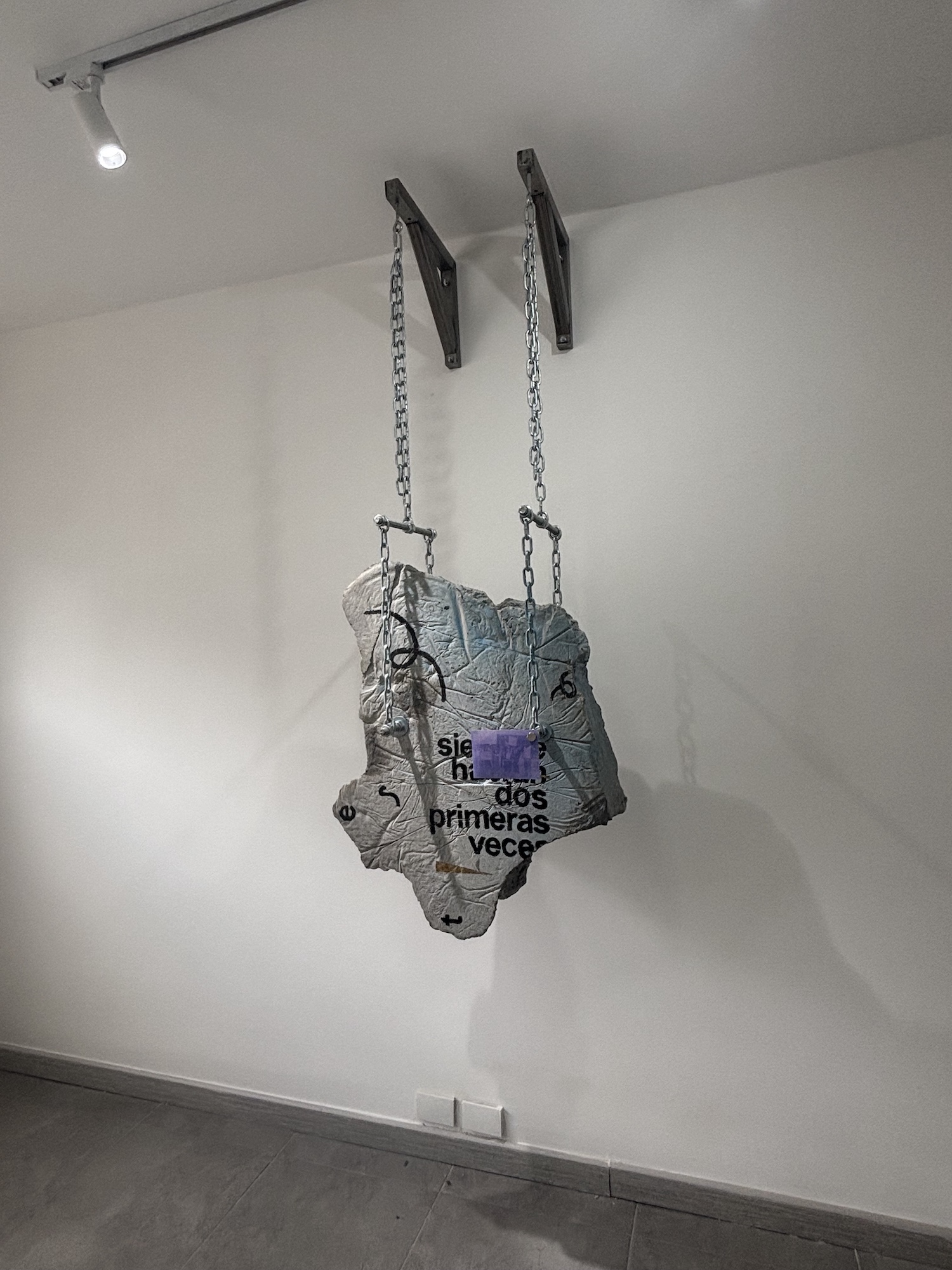
In There Will Always Be Two First Times, Argote constructs a network of architectural, visual, and narrative fragments in which history is not presented as a fixed account, but as a superimposition of layers. Rather than being definitively inscribed, language appears here as something constantly reconfigured between memory, archive, and fiction.
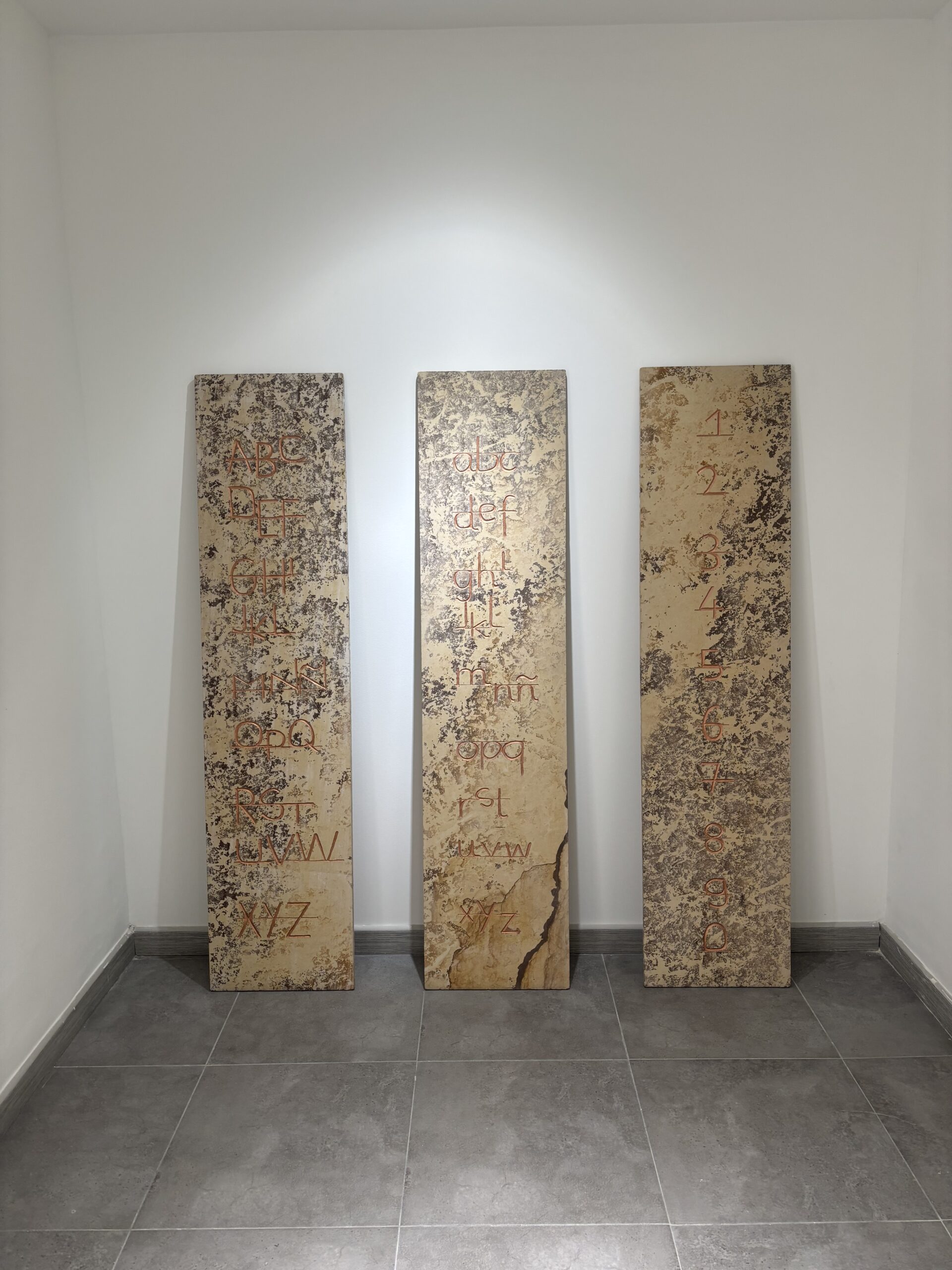
Zea works with typographic systems and administrative records that, once displaced from their operational function, reveal their material condition. While one work reorganizes a curatorial text until it becomes structure, in E-14 writing exposes the processes that structure an electoral system.
In Ramírez’s work, language does not merely name the world, but participates in its configuration. Her pieces propose life as a sculptural experience, where words, like encounters, leave form behind. Rather than operating as a fixed structure, language functions as a relational space: it sustains, conditions, and transforms experience, opening the possibility of being collectively intervened and reconfigured.
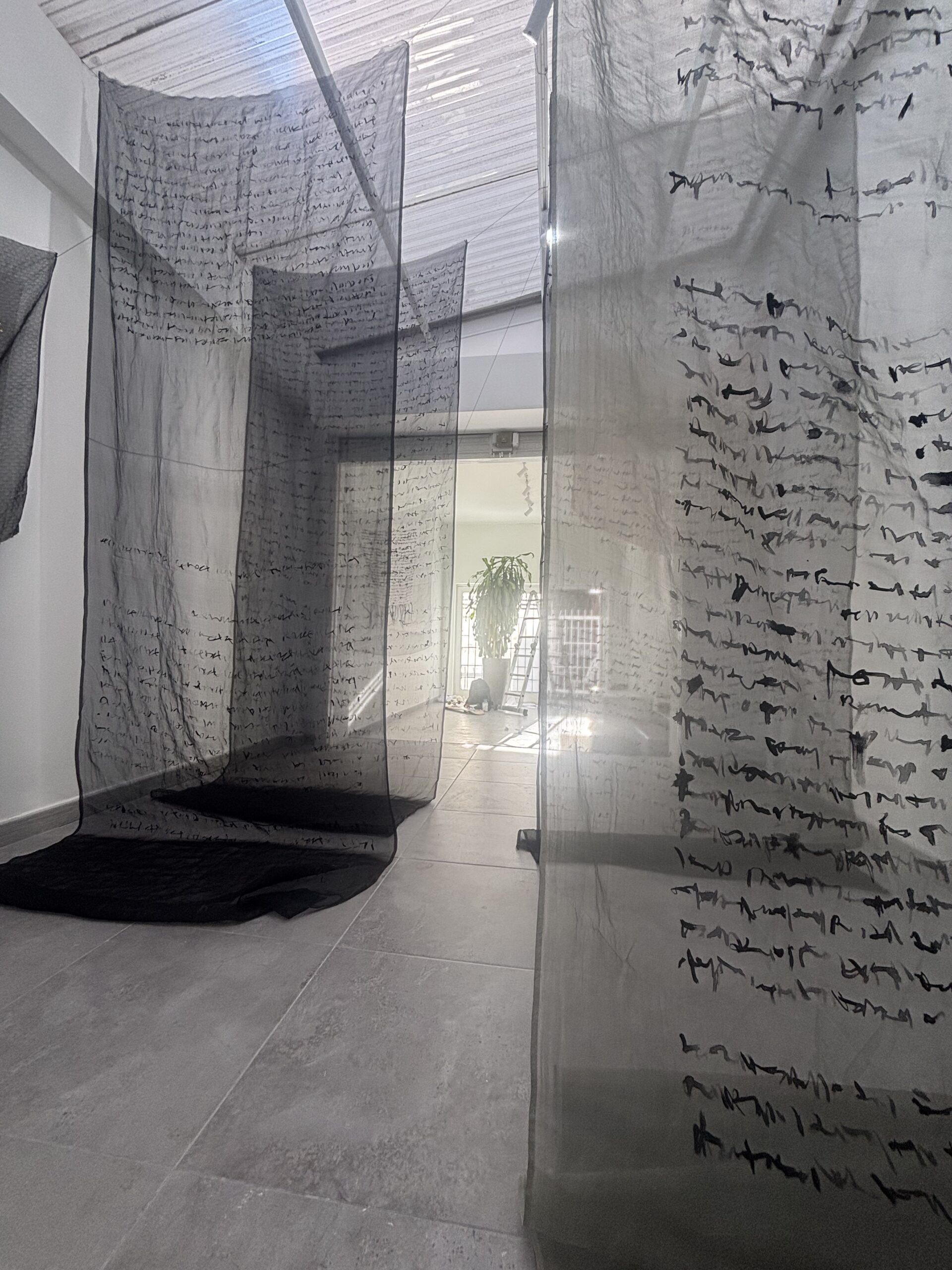
In contrast, the works of Angélica Chavarro and Bipasha Hayat shift writing toward more vulnerable surfaces. In these cases, text does not disappear, but changes condition. On fabric, it becomes repetition, insistence, a gesture approaching the ritual.
In Chavarro’s work, the word moves away from its descriptive function to become action: a repeated writing that insists upon the surface, where text does not fix meaning but rather wears it down. More than transmitting content, her writing records a process: an accumulation of gestures in which intimacy appears not as narrative, but as trace.
In Hayat’s work, writing and its projection introduce a distance: what is read never fully coincides with what is seen. Memory thus appears not as a stable form, but as resonance — something that persists without ever becoming fully fixed.
Between what is carved and what is laid down, the exhibition does not propose a closed opposition, but rather a field of relationships. Stone also erodes. Fabric also preserves. In both cases, language finds ways of remaining, though never definitively.
Even this text — the one now being read — rests upon a surface that supports and inscribes it. Here too, meaning depends upon its support. Perhaps text never fully rests. Perhaps it simply finds where to hold itself… and we decide how much weight to give it.
Submit Your Project
We’re accepting submissions for the CFC Art Guide, featuring exhibitions, projects, and curatorial initiatives on our website and social media. We particularly encourage submissions from underrepresented curators, as well as those working independently or without institutional affiliation. Submit your project here.