







Art Guide: Jennifer West. STITCHED COSMOS, curated by Francesco Urbano Ragazzi
#Art GuideIn this edition of the CFC Art Guide, we spotlight Stitched Cosmos, a solo exhibition by Jennifer West curated by Francesco Urbano Ragazzi that explores the intersections of art and science, analogue and digital image-making, and the overlooked contributions of women whose labour transformed our understanding of the cosmos.
Jennifer West: Stitched Cosmos, curated by Francesco Urbano Ragazzi
Featured artist: Jennifer West
Dates: Until 6 July 2026
Opening times: Monday–Friday, 9:30 am–6:30 pm; Saturday, 9:30 am–12:30 pm
Location: Università Ca’ Foscari Venezia, Dorsoduro 3246, Venice, Italy
Stitched Cosmos marks the first public presentation of the research Jennifer West conducted as part of the Artist Research Fellowship awarded to her by the Smithsonian Institution.
The exhibition centres on the Harvard Astronomical Plate Collection, now held at the Harvard-Smithsonian Center for Astrophysics. Comprising more than 500,000 glass plates bearing photographic images of the universe, the archive captures light travelling from distant galaxies through telescope lenses, giving tangible form to astronomical distances.

Used systematically from the 1870s through the 1990s, these plates represent a pivotal moment in the transition from analogue to digital image production — a subject that has remained central to West’s artistic practice for over three decades.
Yet Stitched Cosmos is not only concerned with the archaeology of scientific imaging. The glass plates also contain thousands of handwritten annotations produced by the Harvard Astronomical Computers, a group of women scientists whose contributions fundamentally shaped the field of astrophysics. Working within systems that undervalued and under-recognised their labour, these women developed methods for classifying celestial objects that continue to be used today.
By revisiting their drawings, annotations and scientific observations, West pays tribute to forms of female labour that have historically remained invisible, both within science and across wider cultural histories.
During her residency at the Harvard-Smithsonian Center for Astrophysics, West focused on a group of damaged and fractured glass plates whose original data had been lost. Through photography, film and collage, she reactivates these fragmented records, transforming them into new visual constellations.

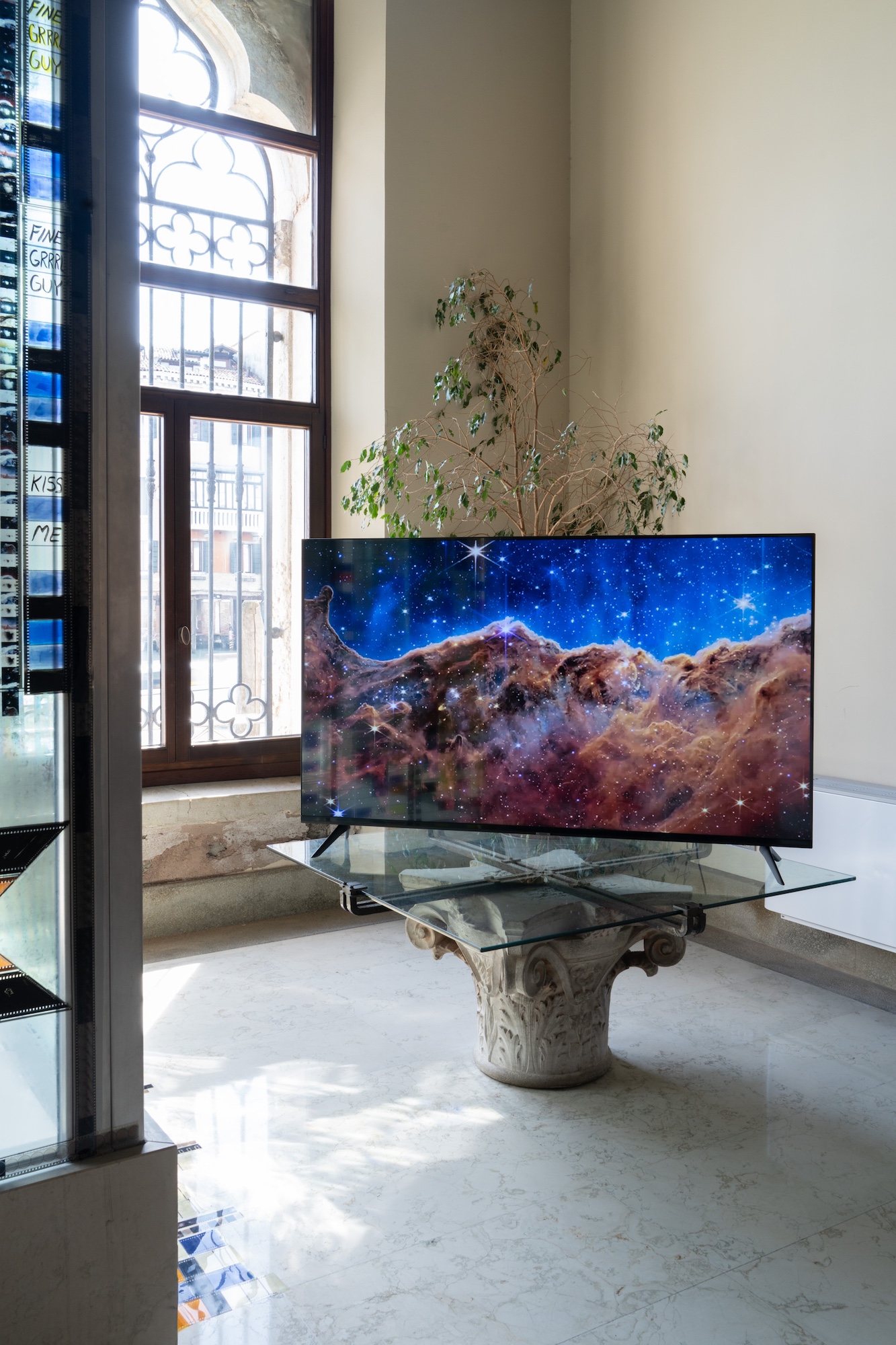
Visitors are welcomed by a series of luminous diptychs in which stars, galaxies and nebulae overlap to create intricate cosmologies. These collages bring historical astronomical images into dialogue with imagery produced by contemporary satellite telescopes, collapsing temporal distances between scientific eras.
Throughout the exhibition, animations displayed across multiple screens expand this visual language further. Accompanied by a soundtrack created by the Japanese collective Open Reel Ensemble, the moving-image works animate celestial imagery while holographic projections lend these astronomical forms a three-dimensional presence.
At the far end of the exhibition, West presents a monumental cinematic installation composed of large quilts made from stitched film strips. Hand-inked 35mm and 70mm film frames intersect to form star-shaped patterns inspired by American quilting traditions. Referencing the colour-coding systems used by the Harvard Astronomical Computers, the work transforms scientific notation into a tactile and luminous sculptural form.
As daylight filters through the university’s glass façade, the installation refracts light across the space, turning Ca’ Foscari University into what the artist describes as a field of attraction between opposites.
Throughout the exhibition, analogue and digital technologies, drawing and photography, art and science, manual labour and theoretical inquiry remain in constant dialogue. Rather than presenting these as opposing categories, Stitched Cosmos reveals them as interconnected systems through which knowledge is produced, transmitted and reimagined.
Presented within the daily life of Ca’ Foscari University, the exhibition continues Francesco Urbano Ragazzi’s long-running Venice Biennale series examining how contemporary art can activate historically significant sites. Here, the university becomes both exhibition space and research environment — a place where scientific history, artistic experimentation and collective memory converge.
About the artist
Jennifer West (b. 1966, Topanga, CA) is a Los Angeles-based artist who has explored the materiality of film for over two decades. She is a 2025–2026 Smithsonian Artist Research Fellow and a 2026 Guggenheim Fellow. Her work spans large-scale moving image installations and site-specific interventions, with major projects commissioned by the Turbine Hall at Tate Modern, the High Line in New York, Frieze Los Angeles, LIAF Biennial, MIT List Visual Arts Center, Aspen Art Museum, among others. In 2022, Radius Books published Jennifer West: Media Archaeology, launched at the Centre Pompidou in Paris on the occasion of Typofilm: Jennifer West. Her work has been presented in solo exhibitions at the Centre Pompidou, Times Square Arts, Yuz Museum in Shangai, Seattle Art Museum, S1 Artspace in Sheffield (UK), Kunstverein Nürnberg (Germany), Contemporary Arts Museum Houston, Contemporary Art Museum St. Louis, Joan Los Angeles, MAN Nuoro, Tramway Glasgow, White Columns in New York, and included in major group exhibitions at the Barbican in London, CAPC in Bordeuax, France, Kunsthalle Schirn in Frankfurt, ZKM in Karlsruhe, the Whitney Museum and the Drawing Center in New York. Her work is held in leading public collections including LACMA, the Hammer Museum, the Getty Museum, Kadist, MONA (Museum of Old and New Art), MOCA Los Angeles, the Thoma Collection, Rubell Collection, the Saatchi Collection and others.
About the curators
Francesco Urbano Ragazzi is a curatorial duo founded in Paris in 2008 by Francesco Ragazzi (PhD) and Francesco Urbano (PhD). Their practice reconnects art with reality through exhibitions that extend beyond galleries and museums, exploring a broader concept of public space. Their approach is exemplified by a trilogy of exhibitions curated in Venice on the occasion of the Biennale: “The Internet Saga” by Jonas Mekas (2015); “Hillary: The Hillary Clinton Emails” by Kenneth Goldsmith, with the participation of Hillary Rodham Clinton (2019); and “Adoration” by Pauline Curnier Jardin and the inmates of the Giudecca detention house (2022). The duo has also developed projects for major institutions worldwide, including the MMCA (Seoul), School of Visual Arts, ISCP (New York), Kunstnernes Hus (Oslo), CERN (Geneva), Maraya Art Centre (Sharjah), Centro Ricerca Castello di Rivoli (Turin), Reykjavik International Film Festival, Centre d’Art Contemporain Genève, La Loge (Brussels), La Casa Encendida (Madrid), Institut Français (Paris), Ikon (Birmingham), Ruya Foundation (Baghdad). In the last five years, they co-edited FUORI!!! 1971–1974, an award-winning anthology dedicated to the first LGBTQ+ magazine in Italian history; they directed the 17th LIAF Biennial in Norway; and curated “Jonas Mekas 100!” in Italy, the international program celebrating the centenary of the legendary filmmaker, with whom they had long collaborated. In 2025, Francesco Urbano Ragazzi was named the first Italian curatorial fellow at the American Academy in Rome.
Submit your project
We’re accepting submissions for the CFC Art Guide, featuring exhibitions, projects, and curatorial initiatives on our website and social media. We particularly encourage submissions from underrepresented curators, as well as those working independently or without institutional affiliation. Submit your project here.