







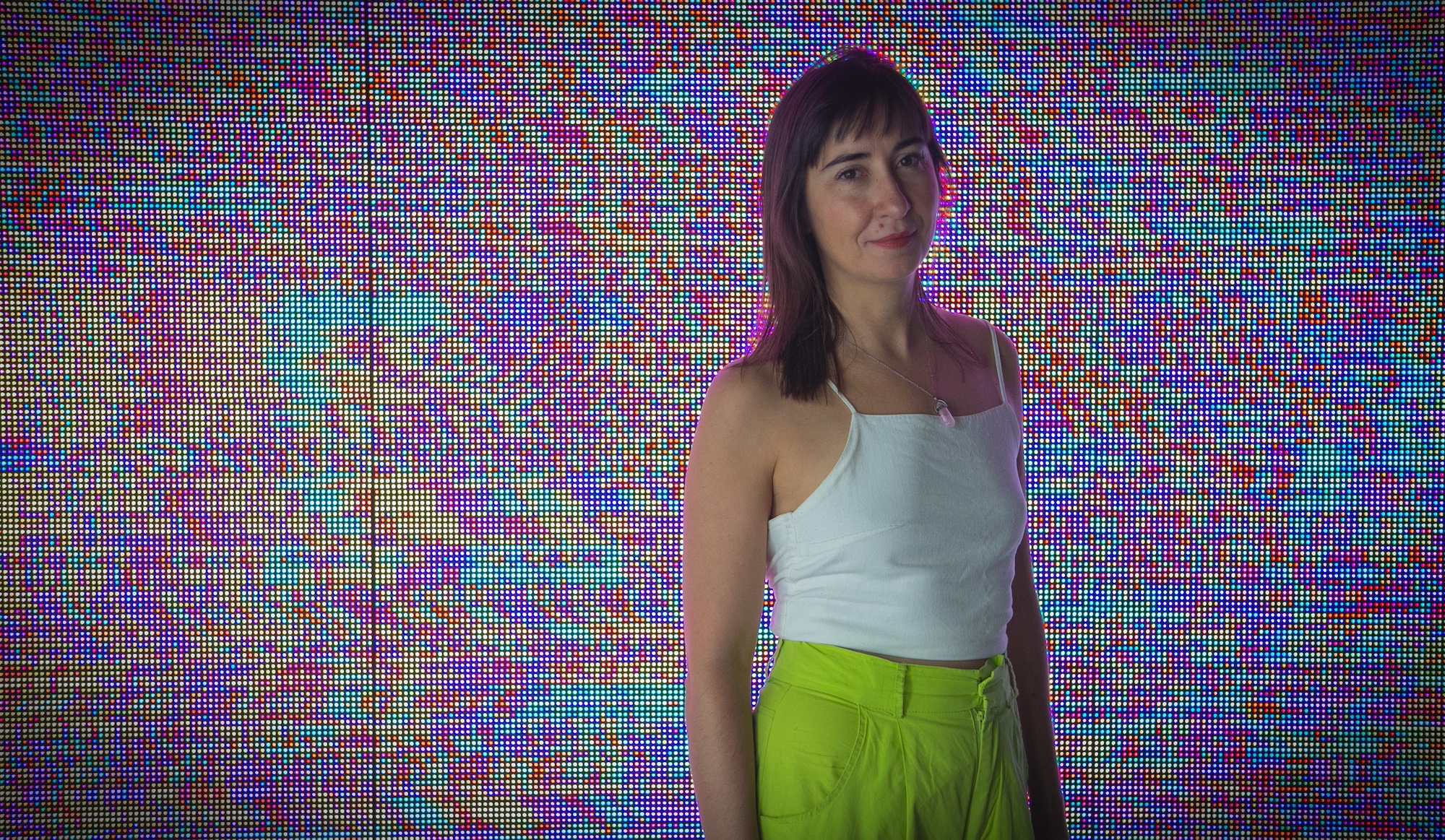
Meet Julieta Agriano: On Curating the Social and Technological Landscapes of Today
#CFC Members Program #interview #Members SpotlightCFC Members Spotlight is a monthly interview series showcasing the work of our members on our blog and social media. Through this series, we highlight the diverse curatorial practices in our community and encourage new connections and exchanges.
Meet CFC Member Julieta Agriano
Julieta Agriano is an independent curator specialised in Latin American Art and Technology scenes. Founder of WIP arte digital, a Latin American online educational platform on digital arts. She works from a social and critical perspective and has developed exhibition projects and research residencies in Buenos Aires (OSDE Foundation, Ministry of Culture and Science and art galleries), CDMX (Centro de Cultura Digital and AI and Art Biennial), Montreal (Hexagram Lab) and Switzerland (Pro Helvetia) and Mexico City.
In our latest Members Spotlight, curator Julieta Agriano traces her journey from the experimental digital art scenes of Buenos Aires to a curatorial practice that bridges technology, politics, and perception across continents.
CFC: What inspired you to pursue a career as a curator? Was there a particular moment or experience that sparked your interest?
JA: It has been an organic process developed over many years. I first worked as a cultural producer and later as a cultural promoter in fields such as music and fashion. Each step I took before becoming a curator stemmed from a desire to go deeper and engage more conceptually with the projects I was involved in. This path ultimately led me to curating, where I found the space to bring all these experiences together: the ability to produce and make things happen, combined with research as a way of staying in constant dialogue with ideas that open new perspectives, connect facts and paradigms, and shape practices.
CFC: What thread or idea ties your work together?
JA: In a world where the flux of images fuels an isolated consumption through the private, black and bright mirrors we carry, exhibition remains one of the few places where audiences can establish a significant kind of interaction with what they see. There, rather than being fleeting elements in a scroll, visual objects, sound and words are situated, enabling multisensorial perception and reflection. In this sense, I think in context as key in curatorial practices, becoming a powerful political approach in exhibitions and a resistance gesture facing the synthetized content tendencies.
CFC: Name a project or exhibition that holds special significance for you. What made it stand out?
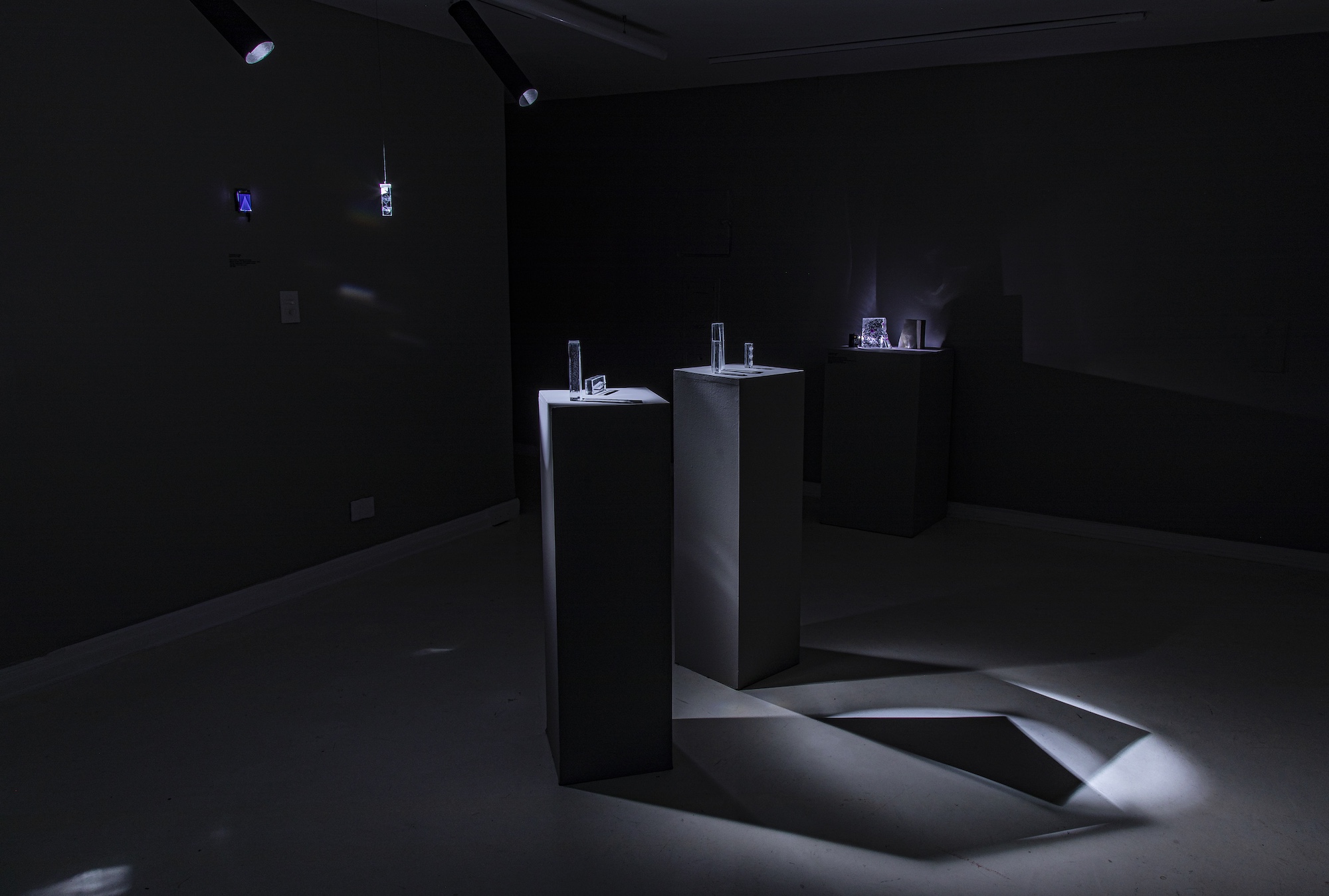
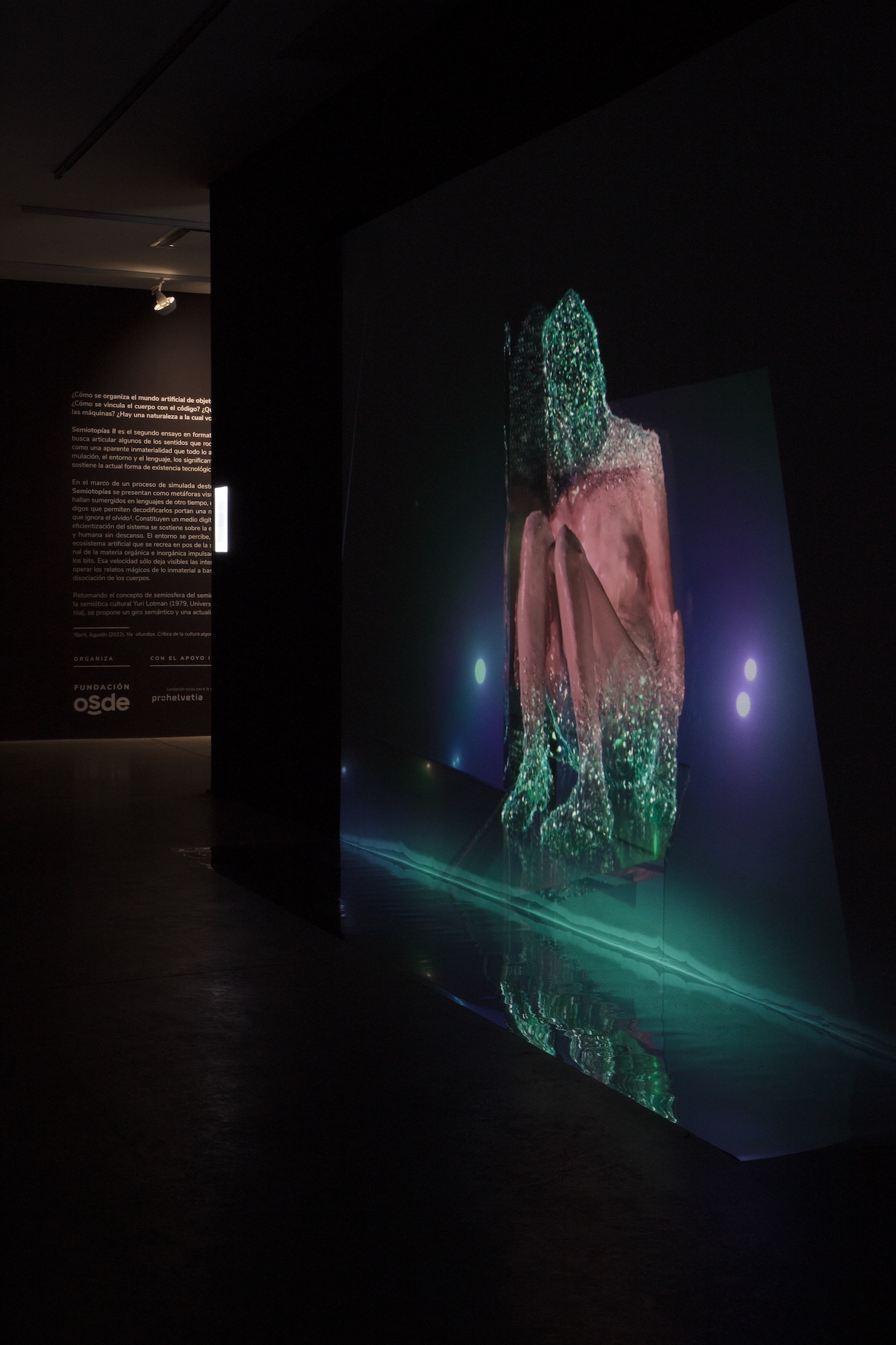
JA: Semiotopías is the curatorial saga (Semiotopías I -2021- and Semiotopías II -2023), where I’ve been developing my research from a semiotic perspective exploring simulation, language, and des-materialization discourse processes in contemporary life: Taking up the concept of the semiosphere developed by semiologist and cultural semiotics expert Yuri Lotman (1979, University of Tartu, Estonia), we propose a semantic shift and an update of the concept in order to articulate some of the meanings surrounding digitality as an apparent immateriality that abstracts everything, with simulation, environment, and language being the signifiers on which the current form of technological existence is based. Within the framework of a process of simulated deterritorialization, Semiotopias are presented as visual metaphors. Their texts are immersed in languages from another time, while the codes that allow them to be decoded carry a non-human memory that ignores oblivion. They constitute a social digital medium, in which the efficiency of the system is sustained by relentless planetary and human extraction. The environment is then perceived as an artificial ecosystem that recreates itself in pursuit of the functional organization of organic and inorganic matter driven at the speed of bits. That speed only leaves visible the interfaces that allow the magical stories of the immaterial to operate on the basis of lithium, copper, and the dissociation of bodies.
CFC: What’s your favourite part about being a curator? And, if you don’t mind sharing, what’s the most challenging?
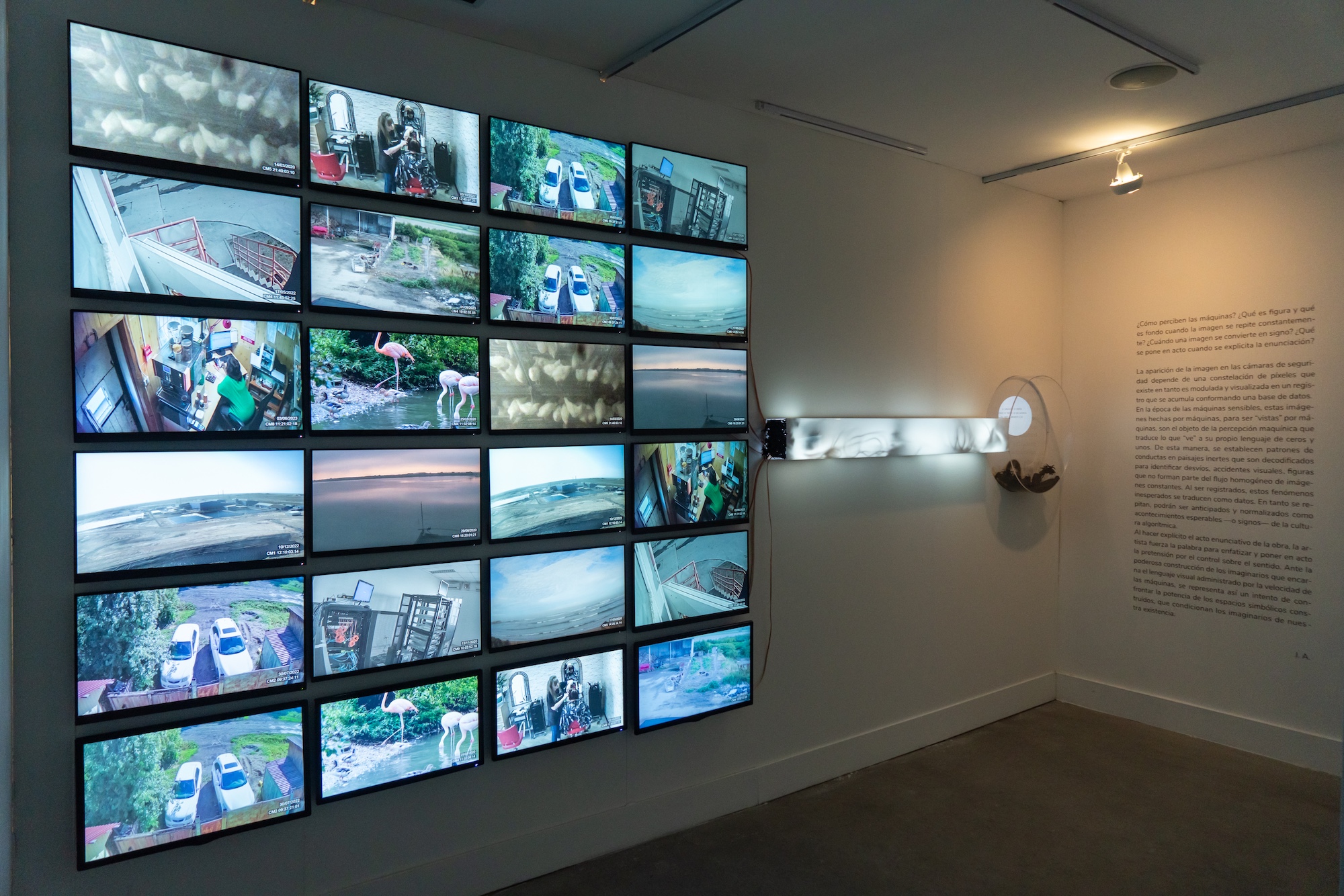
JA: My curatorial practice has focused on digital aesthetics as a lens to explore technology as a political matter in contemporary existence – the technical dimension of the Anthropocene. Through exhibition-essays, my work has questioned the social imaginaries of dematerialization and deterritorialization that sustain Technology as neutral and inherently innovative. My aim has been to deploy these concepts as performative elements in the exhibition. Acknowledging that digital art screening exhibitions often fail in facilitating engagement within the exhibition narratives, I have embraced the physical embodiment of digital artworks within spatiality as a methodology. As an expanded practice, I have designed sculptural and installation displays that, in dialogue with artworks’ nature, make digital art exhibitions less opaque and accessible.
CFC: What advice would you give to aspiring curators just starting their careers?
JA: I would say: cultivate a practice rooted in curiosity, listening, and long-term commitment. Curating is not only about articulating ideas, it is about building the conditions for others to create, experiment, and be heard. This requires patience, care, and the willingness to understand contexts beyond your own.
Develop a strong research practice. Read widely, follow the threads that genuinely move you, and let theory, history, and lived experience inform each other. At the same time, stay close to artists. Pay attention to how they work, what they need, and the realities they navigate. Many of the most meaningful curatorial insights come from conversations that unfold slowly over time.
Be open to multiple roles. Production, mediation, writing, fundraising, administration. These are not secondary tasks but part of the backbone of curatorial work, especially in early stages. The art world is a complex space, and its dominant narratives rarely reflect the multiplicity of experiences shaping our present. Seek references beyond the centers of cultural power; engage with practices from the so-called Global South, with local scenes, and with artistic languages that challenge established frameworks. Curating should be a way of expanding the horizon for all of us.
CFC: What does ‘success’ look like to you in curatorial work, and has that definition changed over time?
JA: For me, “success” in curatorial work has shifted from producing ambitious exhibitions to cultivating meaningful processes. Today, success means creating conditions where artists feel supported, where dialogue can unfold with care, and where overlooked perspectives can gain visibility. I value projects that open questions, build relationships, and leave lasting traces in their communities. In this sense, success is less about spectacle and more about curating with a context rather than for it.
CFC: What’s something unexpected or surprising you’ve learned through your curatorial work? This could be about art, people, institutions—or even yourself.
JA: One of the most surprising things I’ve learned through curatorial work is how much the process depends on navigating uncertainty with others. Beyond concepts and methodologies, curating reveals the deeply human side of art making -the vulnerabilities, negotiations, and emotional labor that shape every project. I’ve also learned that institutions, regardless of their scale, often rely on invisible forms of care and communication to function. And perhaps the most unexpected discovery has been about myself: that my role is less about control and more about holding space for listening, adapting, and allowing projects to unfold in ways that I couldn’t have anticipated at the start.
CFC: Any hot takes on the current state of the curatorial field or the art world in general? What do we need more or less of?
JA: We need to approach art exhibitions addressing clearly the political matters that cross our practice: it is THE time to be really engaged from our narratives and relationships with all the art ecosystems, from artists to powerful institutions, we need to display how (at least in my speciality area), technology is a matter of politics in very concrete ways affecting and modeling our social personal life.
Explore more of Julieta Agriano’s work on her website.
Are you interested in learning more about our CFC membership? Dive into how to become a CFC member here.