







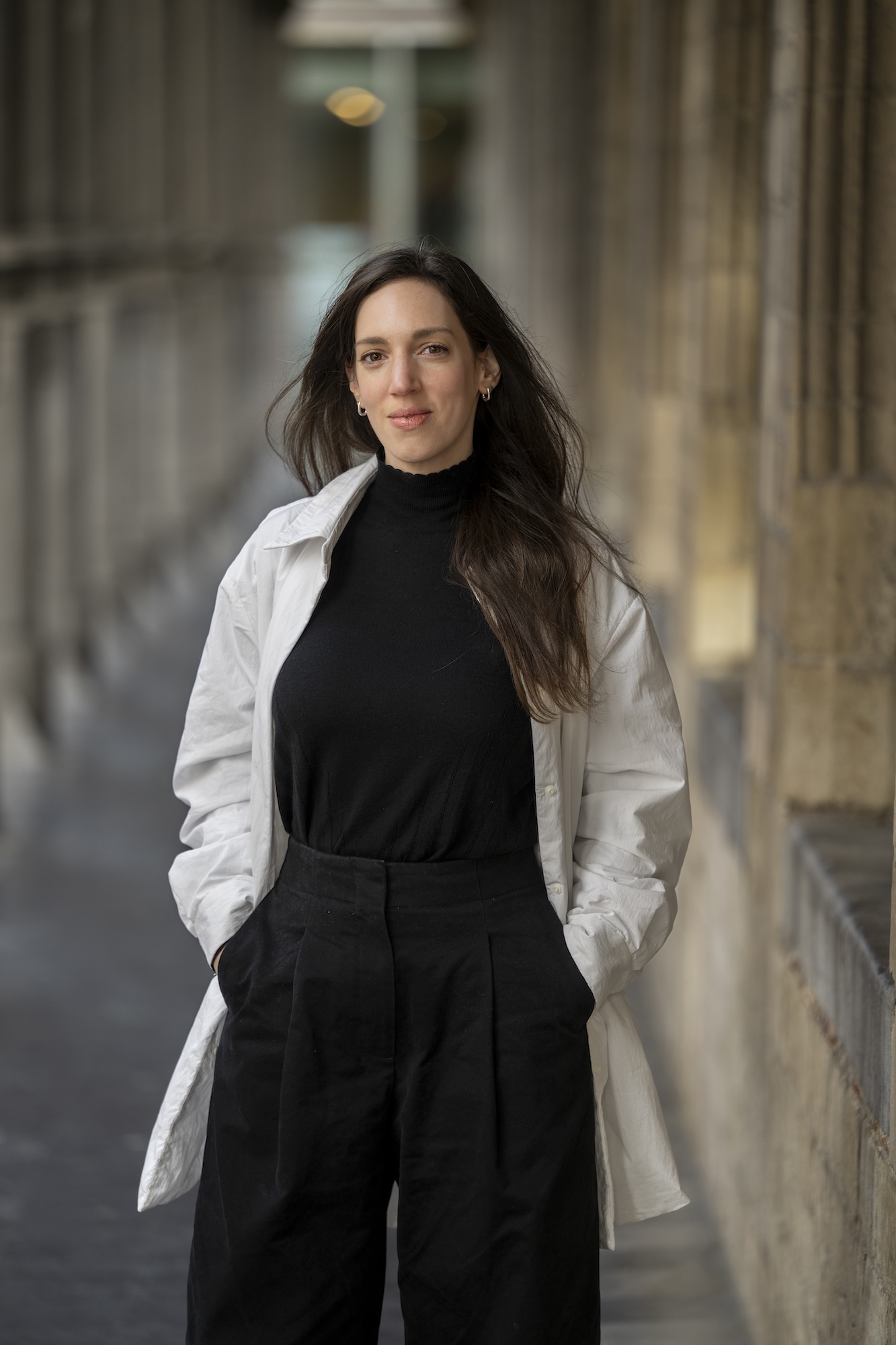
Sofia Lemos on Contour Biennale 11: Curating the Imaginal, Transformation and the Moving Image
#Biennale #curator #interviewRecently, Sofia Lemos was appointed curator of the 11th edition of Contour Biennale, taking place in Mechelen, Belgium, from 5 September to 1 November 2026. Titled The Eyes of the Heart and the Soul of the World, the biennale explores the imaginal as a space of potentiality for personal and planetary transformation, bringing together film, sound, sculpture and installation.
As she prepares for the upcoming edition, Call For Curators invited Lemos to reflect on her curatorial trajectory, her longstanding engagement with ecological and community-based practices, and her vision for a biennale unfolding at a moment of profound structural, political, environmental and social change.
Building on Contour Biennale’s history as a platform for moving image and artistic inquiry, The Eyes of the Heart and the Soul of the World approaches images as forces capable of moving us and mobilising change. Through questions of imagination, transformation and collective possibility, the edition also considers the role of the biennial today: what it can offer artists, local communities and audiences while becoming part of an institution undergoing its own process of transformation.
CFC: Can you tell us about your journey? How did you get started in curatorial work and what drives your passion today?
I came to curating somewhat unexpectedly. My background is in law, philosophy, and political science, and during my first year as an undergraduate student, I began organising screenings, talks, and round tables with filmmakers, artists, and poets as a way of fostering my curiosity beyond the limits of my formal education. My family had no connection to museums and I had seen relatively little contemporary art, yet many of my closest friends were aspiring artists and architects, so creating spaces for dialogue felt like a natural path. It was through that informal practice that I encountered Paul Preciado, whose work had just appeared in Spanish, and I eventually moved to Barcelona to enroll in MACBA’s Independent Study Programme under his direction. I was later invited to work at the museum and that experience was formative in a specific way: it was where I first understood that curatorial work could allow me to be deeply involved in political questions without having to work within the constraints of politics itself.
From there, I moved to London and worked with the late Vincent Honoré, whose vivid imagination, sustained dialogue with artists, and understanding of how exhibitions could move the body and the emotions taught me that theatricality and criticality were not opposing instincts but complementary ones. During this time, I also had the opportunity to attend Irit Rogoff’s lectures on visual cultures, which were formative to my thinking. Later, in Berlin, learning from and working with Anselm Franke at HKW deepened my understanding of how curatorial formats can reframe and expand critical thought. Together, these experiences convinced me that curating is as much about articulating a vision as it is about making complex ideas accessible through dramaturgy, spatial experience, and forms of public encounter.
At Nottingham Contemporary, I developed long-term research and live programmes that brought artists, scholars, and communities into sustained conversation, exploring questions of ecology, sound, and collective world-making through commissions, symposia, and publications. Those years taught me that the most meaningful institutional work happens not through single exhibitions but through sustained frameworks that place artists and cultural organisations on equal footing with the broader knowledge ecosystem. Working with academic partners, outreach, and public space, I began to understand institutional practice as the work of creating the structures and conditions through which artistic practice can resonate and continue to shape public life.
Later, at TBA21 and TBA21–Academy, where I was invited to imagine a new research centre for art and ecology, I developed a model for artistic research centred on long-term fellowships, regenerative cultural practice, and transdisciplinary collaborations that connected artistic production with environmental and social questions. We introduced the model in Andalusia, where artists were invited into three-year research fellowships that combined a stipend, production budget, residency time, and sustained engagement with communities across the region. We also initiated annual convenings in Córdoba designed to support artists making their research public and to generate creative communities around their work. This process led me toward questions that now feel central to everything I do: how cultural institutions can leave more than they take — through resource redistribution, new acquisition models, intentional protocols, both internal and programmatic, and long-term commitments to the ecosystems, both artistic, human and more-than-human, in which they operate to generate actual impact.
Across these roles, I have learned to treat certain questions as elemental: Who is a programme intended to engage, and who is absent from that conversation? How can an institution contribute meaningfully to existing efforts rather than duplicating or displacing them? How can international networks be leveraged in ways that genuinely benefit local scenes and communities? What does long-term alignment between artistic expression, institutional vision, and public desire look like in practice? These are the questions I bring to every context I work in — whether a biennial, a museum, or a private foundation — and they reflect a curatorial practice that has always understood exhibition-making as one tool among many, alongside public engagement, organisational strategy, and the longer work of building capacities, contexts, and formats where artists, organisations, and audiences can strengthen the cultural, social, and ecological conditions that sustain possibility over time.
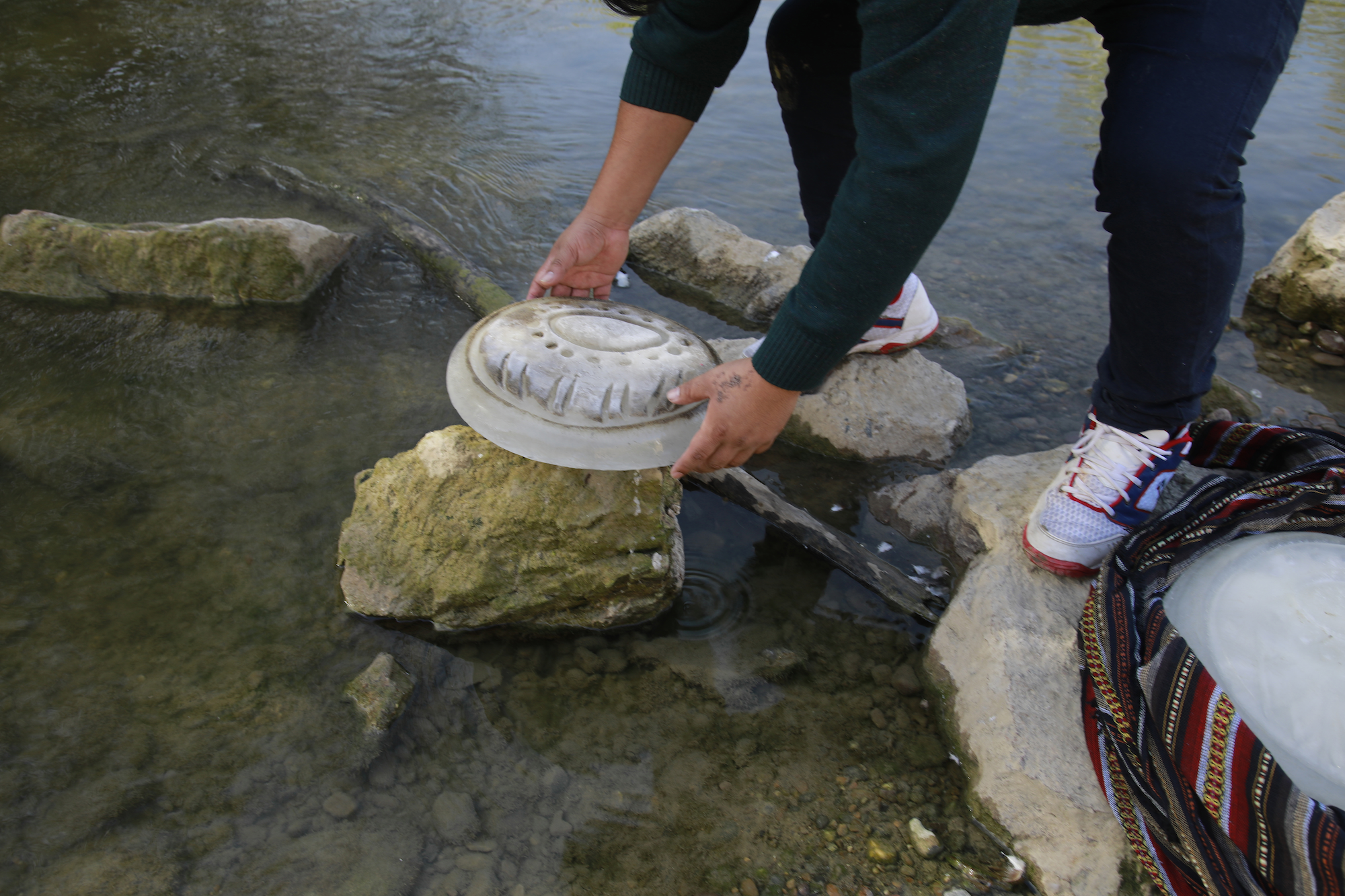
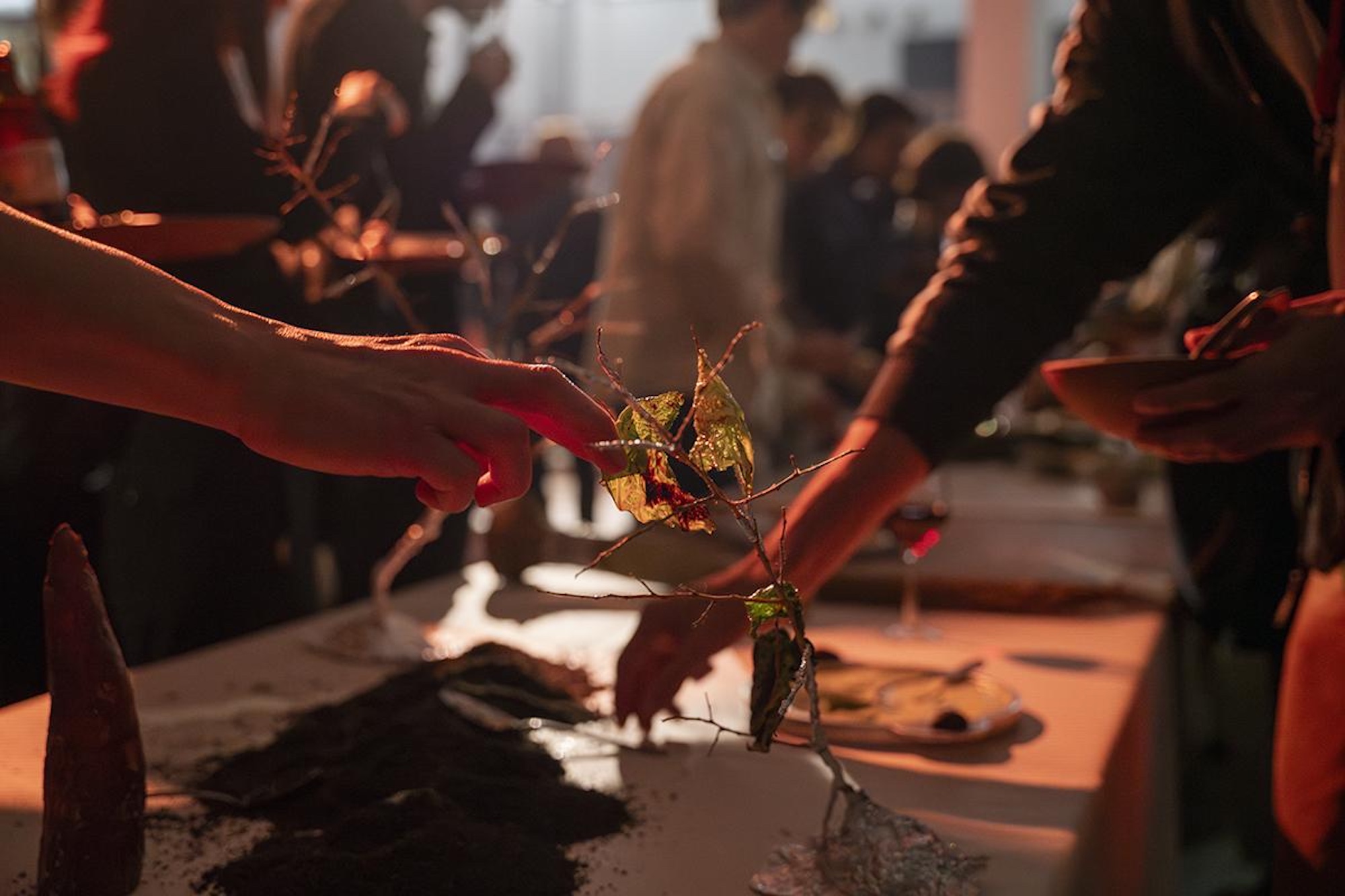 Caiqui Tizzi, Flora Incognita: An Edible Landscape (2025). Installation view at “Artificious Faunalia”, co-curated with Daniel Steegmann Mangranè and Juliana Fausto. September 28, 2025, Wiels, Brussels. Photo: Alhasan Yousef. Courtesy of the artists and Wiels.
CFC: This edition of the Contour Biennale is called “The Eyes of the Heart and the Soul of the World”. Can you tell us what inspired you to explore the potential for personal and planetary transformation, and why this theme is urgent today?
The title begins from a simple conviction: the ecological, political, and symbolic crises we are living through are also crises of perception. I found myself returning to what Persian philosophers and mystics between the twelfth and seventeenth centuries called ʿālam al-mithāl — the imaginal world — a register of reality that is neither purely material nor purely abstract, but where images become active forces capable of shaping experience. It is through this realm, later described as “the world of the soul,” that images speak to the eyes of the heart: not the physical eye dominant in Western metaphysics, but a faculty of perception able to hold together intuition, sensation, imagination, and thought. What interests me is what it would mean to recover that faculty today — not as a form of mysticism, but as an epistemology and an everyday practice: a way of learning to perceive differently.
We are living through a moment when the future itself feels foreclosed, when many people — especially younger generations — describe a kind of paralysis in the face of planetary transformation. My intuition is that this paralysis is partly a failure of perception in the deepest sense: we have lost the capacity to see ourselves as extensions of the world, to recognise change as the very condition of life, and to imagine political, economic, and social forms beyond those we already inhabit. It was important for me then that the experiences we tend to associate as intimate and personal are understood as shared conditions of human and more-than-human life. In that sense, personal and planetary transformation are not analogous; they are the same threshold, experienced at different scales.
For me, the ecological crisis is not one crisis among others — it is the condition within which all the others unfold, and perhaps the most urgent invitation to reconsider how we perceive the world and our place within it. Since the Persian mystics first described the imaginal, the field of perception has expanded beyond the human alone. Our task is no longer simply to understand the world of emotions and experience through the human mind, but to attend to them across species, machines, algorithms, and living landscapes. With what kind of presence — and through which eyes — becomes the pressing question. Art, and moving images in particular, offer a mirror in which the world reveals itself, looking back at us with the force of recognition, asking to be seen in return. They can cultivate that kind of attention, inviting us to perceive transformation before its reality is imposed upon us by circumstance.
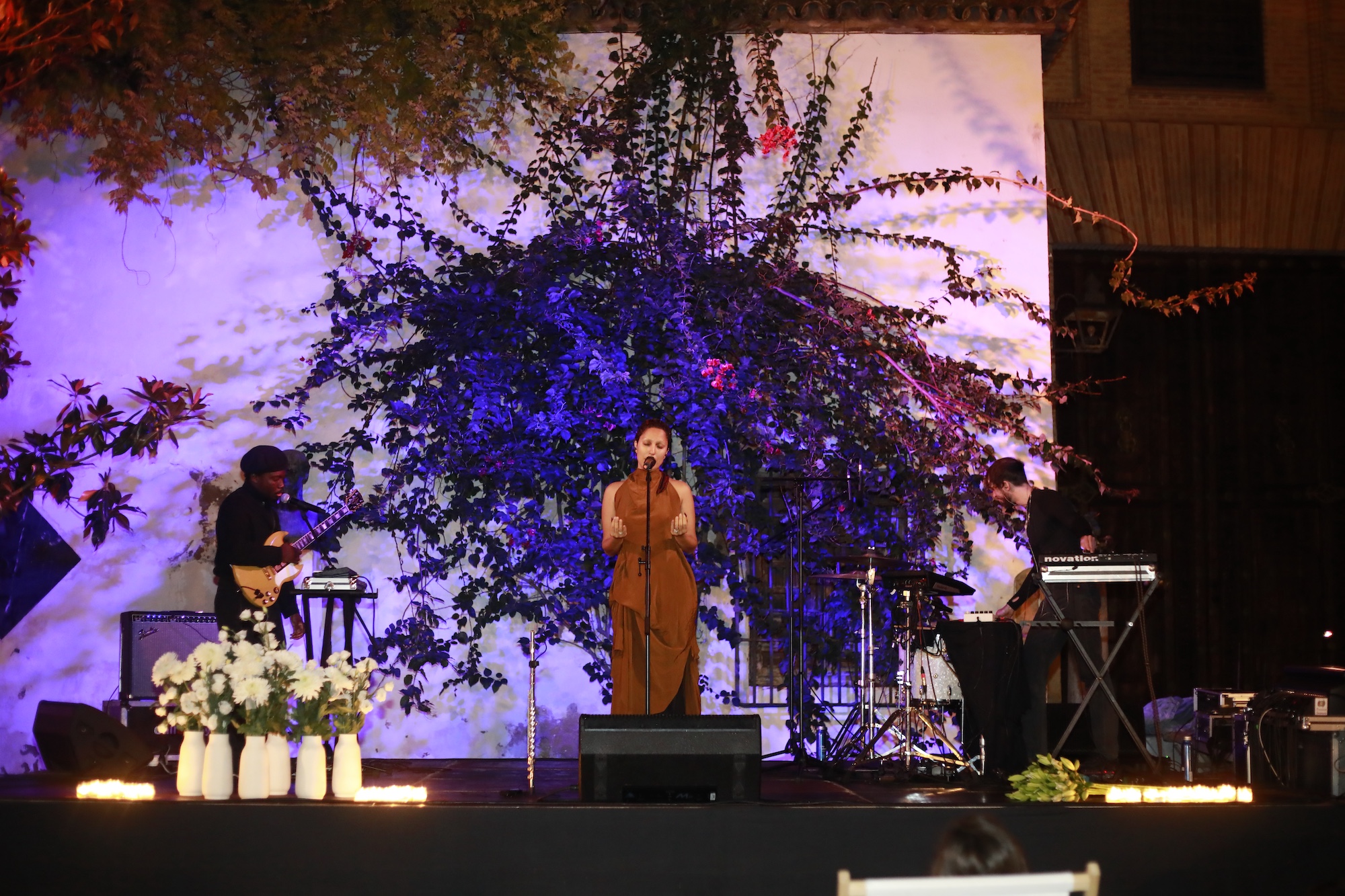 Lafawndah, The Dawn of Everything, vigil for Gaza with Sébastien Forrester on percussion and Coby Sey on voice and guitar at Plaza de Jerónimo Páez, November 11, 2023, Córdoba. Photo: Lourdes Cabrera. Courtesy TBA21–Academy.
CFC: Contour remains one of Europe’s few biennials dedicated to the moving image. What possibilities does the moving image offer for exploring the themes of this edition?
Moving images are uniquely placed to think about transformation largely because they naturally unfold over time: through duration, rhythm, memory, anticipation, disappearance, and return. They ask us to inhabit change. That has become increasingly important to me. I have been thinking less about artists’ film and moving image as a medium than about images that move us and mobilise change: images capable of reorienting perception and organising time. In that context, perception and transformation function not only as themes but as a methodological approach. Many of the works in this edition extend beyond the medium altogether, inviting visitors to experience moving images spatially, sonically, bodily, and across the city itself.
Moreover, Contour has the scale to remain genuinely experimental, which also means that each edition has the opportunity to redefine what a moving image biennial can be. Across its ten editions, the field itself has undergone a profound transformation. Dedicated foundations and production platforms have emerged with unprecedented commissioning capacities, while public funding for artists has become increasingly limited. Artists once identified primarily with the moving image now work fluidly in cinema, and the ways we encounter artists’ film have shifted through streaming platforms and computer screens. At the same time, a new generation of artists and audiences has already grown up with digital screens and an awareness of the role of images that my generation didn’t have. And equally importantly, image-making is no longer exclusive to humans alone. Against this rapidly changing landscape, I believe Contour is not simply a biennale to exhibit moving images, but to question and sustain how the moving image itself is fundamentally changing.
CFC: You mention that curating this edition means becoming part of Contour’s own transformation. What does this transformation look like, and how would you like to contribute to it?
I was seven months pregnant when I interviewed for the role, so perhaps it was inevitable that I would recognise something matrescent in the institution itself. Contour is entering a new cycle, with a renewed team, board, and vision. Like any period of transition, it brings uncertainty and the challenge of building new structures, but it also creates an openness to imagine what the biennial might become.
That openness has been both a creative opportunity and a practical challenge. This edition operates without structural funding, which has meant that a significant part of my work has been oriented toward developing partnerships, co-productions, and fundraising — building the financial and relational architecture that makes the artistic programme possible in the first place. That experience confirms something I already believed: curating is also ecosystem-building, and relies on the capacity to articulate a vision to different interlocutors — artists, funders, civic partners, and communities alike — and to do so compellingly in each case.
I hope to contribute to Contour’s longer transformation by strengthening its identity as a biennial that values artistic production, takes genuine risks, and develops lasting alliances across the ecology of foundations, galleries, collectors, and public institutions that sustain artistic practice over time. I also hope the organisation takes significant steps in developing frameworks that deepen relationships with artists, curators, funders, and the city itself. My hope is that this edition leaves behind not only a moving experience but alliances, working methods, and institutional knowledge that continue to support artists long after the exhibition closes.
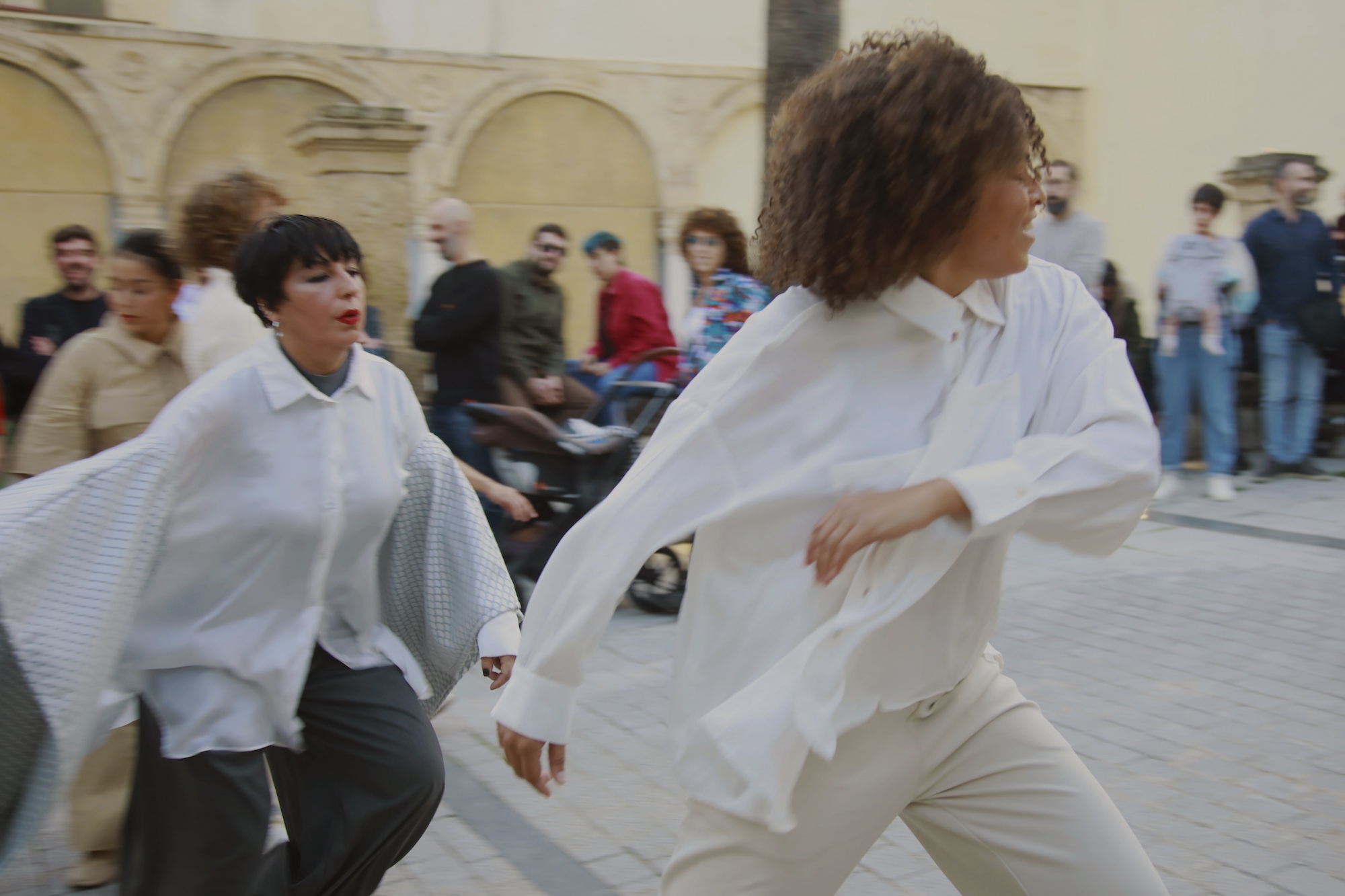 Isabel Lewis, Walking Spirals: An Occasion to Consider Other Ways of Getting to Know This River, with culinary offerings by Caique Tizzi and contributions by Guillermo Castro Buendía, Carlos López Campos, Javiera de la Fuente, Brooke Holmes, Helena Martos, Laila Tafur, and Rosário Vacas, performance at Claustro de los Abrazos Perdidos, November 11, 2023, Córdoba. Photo: Lourdes Cabrera. Courtesy TBA21–Academy.
CFC: Biennials are increasingly being asked to justify their relevance. What do you think biennials can offer artists and audiences today that other exhibition formats cannot?
A biennial gives you scale and time in combination and the opportunity to meaningfully engage with a city, its communities, histories, and architectural textures. That allows for a dramaturgy of experience to unfold — an experiment with moods, rhythms, and intensities that prepare the visitor on an emotional and psychological register.
What is being asked of biennials now, I think, is to justify that scale and risk with genuine depth — to become more modest in ambition while becoming more ambitious in commitment. Rather than producing ever-larger exhibitions, biennales can invest in artistic production: higher fees, longer research and residency periods, experimental and accessible formats for public outreach and meaningful relationships with local communities that endure rather than rely on extractive logics. Fewer works, perhaps, but more time and greater depth.
Ultimately, a biennial is one of the few art institutions that speaks almost entirely through the language of an exhibition and its public programme. That simplicity is precisely its strength: every edition holds the possibility of reinventing not only its own form, but the kinds of internal protocols and public conversations that contemporary art can make possible.
CFC: How do you balance an international curatorial vision with a meaningful engagement with the local context of Mechelen?
I don’t think those are actually in tension, provided the local is approached as a source of meaning and experience rather than a site requiring direct response or programmatic resonance. Instead of treating Mechelen as a backdrop, we have considered its architecture, histories, and landscapes as active participants in shaping the exhibition. Concretely, that has meant allowing the city’s historical and spiritual textures — its beguinages, religious and civic architecture, and gardens — to frame the dramaturgy of the parcours, rather than imposing a curatorial framework upon them.
Experiences such as gestation and birth, childhood and adolescence, ageing, love, and loss are shared across cultures, even as they are lived, understood, and narrated differently. My approach has been to acknowledge the singularity of Mechelen through the parcours while engaging the shared humanity the artworks open onto. The artists enter into dialogue with places that carry their own histories of threshold and transformation, and each site shapes the encounter with the work in turn.
That relationship between artwork and architecture is also where my methodology becomes most tangible. For me, a good exhibition has to be felt in the body, in the senses as much as in the mind. I often think about how different works create shifts in tempo, attention, and feeling: how some require a particular quality of presence and sustained attention to fully reveal themselves, while others carry an operatic intensity of their own. Together, they form a cadence in which each work maintains its singular voice and its dialogue with the space, while contributing to the experience of the whole. The walk between venues also becomes part of the curatorial work: architecture, weather, anticipation, and encounter all begin to shape how works are received and how they recontextualise one another as visitors find their own paths.
Mechelen has a strong connection with its heritage, and, ultimately, this edition offers a renewed look. Whether you’re rediscovering a place you’ve known for years or encountering it for the first time, the invitation is the same: to attune ourselves to what exceeds the visible, to the ecologies that sustain both place and life.
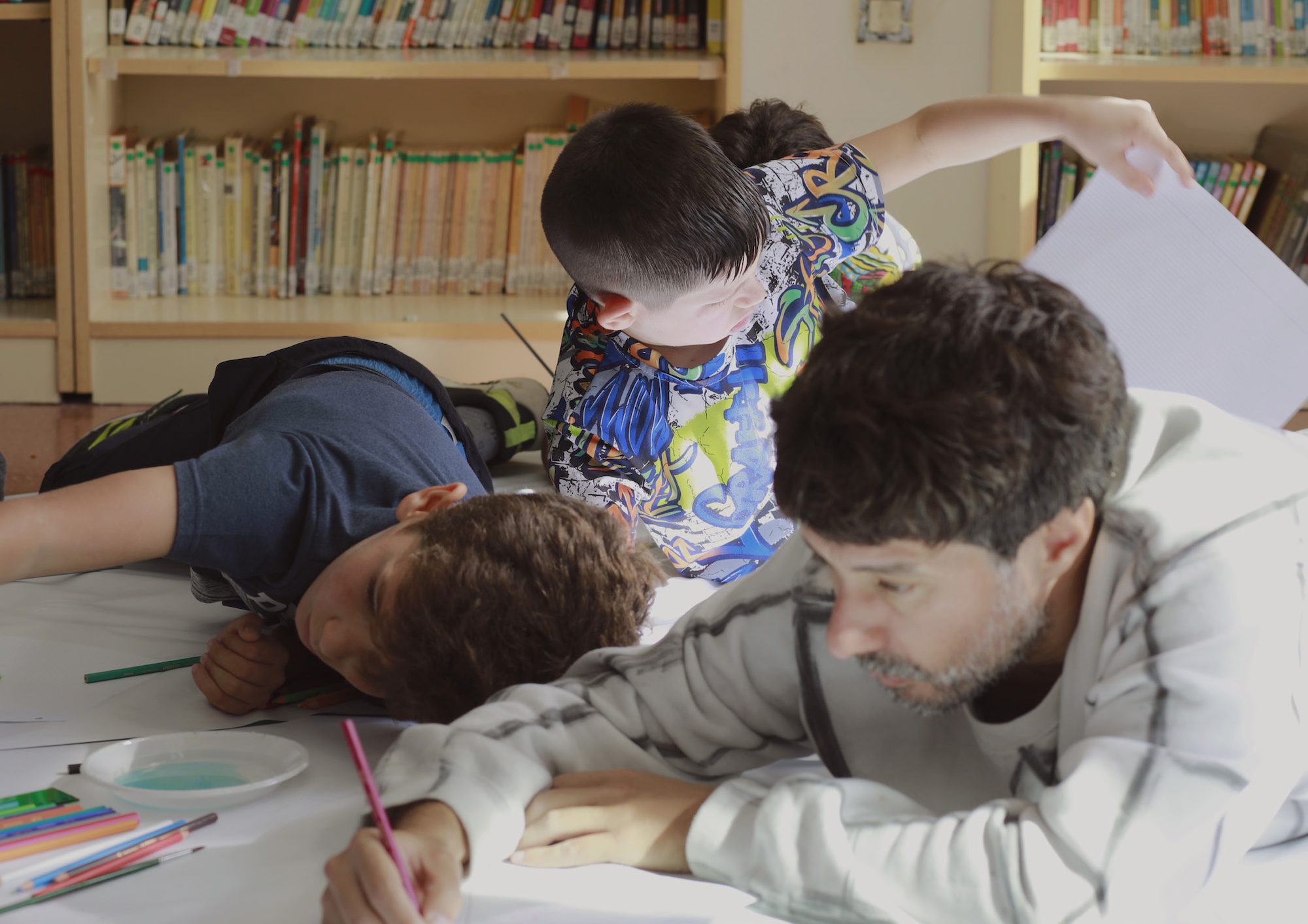 Eduardo Navarro, How Can We Investigate the Future?, drawing session with Colegio de Educación Infantil y Primaria La Paz, November 9, 2022, Córdoba. Photo: Lourdes Cabrera. Courtesy TBA21–Academy.
CFC: Whose work are you currently returning to again and again while preparing this biennial?
While the exhibition has become a conversation between artists I have worked with over many years and others encountered more recently, I find myself returning often to the work of Yuyan Wang, Rodrigo Hernández and Laure Prouvost, for very different reasons.
Working with the endless circulation of digital images, Yuyan reveals the connections of technology, extraction, desire, and exhaustion, refusing the long-standing opposition between the organic and the technological. In her films, petrochemical landscapes, machines, and synthetic bodies become strangely vulnerable, inviting us to recognise feeling as something that traverses matter itself. Rodrigo also has an extraordinary ability to think through images. His sculptures and paintings move effortlessly between mythology, archaeology, science, and dreams, creating visual worlds that remain open rather than symbolic in any fixed sense. Laure, meanwhile, works through sensation. Her installations ask us to experience language, sound, movement, and memory bodily before they become concepts.
The three artists, in different ways, remind me that images are never only things we look at — they are mirrors in which the world reveals itself, and us within it.
Sofia Lemos is a curator and writer whose work engages the intersections of art, performance, and discourse, with a sustained focus on ecology and critical practice.
From 2021 to 2024, Lemos was Curator at TBA21—Thyssen-Bornemisza Art Contemporary, where she launched a programme centred on ecological and community-based practices, commissioning new work and convenings artists, performers, and thinkers. Between 2018 and 2021, she served as Curator of Public Programmes and Research at Nottingham Contemporary, where she developed live and collaborative projects, including the multi-year Sonic Continuum, exploring the sonic and its relationship to social change.
Lemos was associate curator of the 2nd Riga Biennial (2020), a visiting curator at Galeria Municipal do Porto (2017–18), and collaborated on the public program of Contour Biennale 8 (2017). She has curated exhibitions and programmes with multiple international institutions, including Culturgest, Galerias Municipais de Lisboa, Serralves Museum, Frac Sud, Kunstinstituut Melly, MACBA, MAMBA, and Haus der Kulturen der Welt, among others.
She edited Reluctant Gardener (Bom Dia Books, 2025), Meandering: Art, Ecology, and Metaphysics (Sternberg Press, 2024), Sonic Continuum (Nottingham Contemporary, 2021), and Metabolic Rifts (Anagram, 2019, with Alexandra Balona). Lemos lectures regularly and contributes to international publications, including e-flux criticism, Frieze, Mousse, and Spike.
Profile photo by Filip Claessens.